
Here's a look at the new Infographics banner ad as seen on Product Design and Development's website www.pddnet.com
Wednesday, September 15, 2010


Wednesday, August 25, 2010
Case Study: PIPS Technology Production Line Graphics
PIPS Technology is an industry leader in the development and manufacture of ALPR (Automated License Plate Recognition) systems. Their broad range of ALPR products provide the next generation of information technology for Travel Time Measurement, Law Enforcement, Tolling, Congestion Charging, Access Control, Traffic Monitoring and Automated Site Security Solutions. PIPS products are manufactured to ISO 9001:2000 standards.
PIPS TECHNOLOGY originally recruited a team of knowledgeable, highly skilled production people to get the production lines working efficiently and keep them focused on quality. PIPS wanted to maintain those attributes no matter how many more people they added to their production staff. They also wanted to take steps to assure the same level of performance and productivity, with a goal to improve both. Realizing that new line workers did not have the experience and insider-knowledge advantages of their initial crew, the PIPS production team wanted to provide every advantage they could to help the new workers achieve those qualities as quickly as possible.
Infographics approached PIPS with the idea of using production line graphics - an easy, visual reference tool and aide for each workstation and worker. On-site references would help in the retention of critical assembly information and avoid costly assembly mistakes.
OBJECTIVES
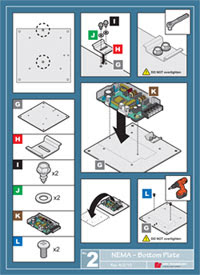 Infographics® APPROACH
Infographics toured the plant and made notes on the environment we found and the opportunities we saw to effectively present information to the assembly line audience. PIPS Technology had documented all the production steps and created temporary manuals for training, but they weren't completely convinced they were going to be an effective reference for the expansion of workstations, the new workers, or daily use.
Infographics implemented our own learning process by taking a hands-on approach. A member of our information design staff went through all the assembly process using the actual parts and tools to better understand the final product and to help our client identify the most critical and costly chances for mistakes. Infographics concluded that small full-color posters could be displayed strategically throughout the production areas to address the most "critical" steps.
Infographics presented a list of proposed visuals and together with the PIPS key production personnel concluded that we could address just two critical steps in the assembly of these products and create potential time and cost savings.
infographics® SOLUTION
PIPS TECHNOLOGY originally recruited a team of knowledgeable, highly skilled production people to get the production lines working efficiently and keep them focused on quality. PIPS wanted to maintain those attributes no matter how many more people they added to their production staff. They also wanted to take steps to assure the same level of performance and productivity, with a goal to improve both. Realizing that new line workers did not have the experience and insider-knowledge advantages of their initial crew, the PIPS production team wanted to provide every advantage they could to help the new workers achieve those qualities as quickly as possible.
Infographics approached PIPS with the idea of using production line graphics - an easy, visual reference tool and aide for each workstation and worker. On-site references would help in the retention of critical assembly information and avoid costly assembly mistakes.
OBJECTIVES
- PIPS management wanted to make sure the quality of their manufacturing remained, as well as, their control over materials costs.
- Identify the most critical, and potentially costly mistakes that could be made in the process to address with visual aids.
- Use wordless graphics to present the steps and make them easy to view and understand, as well as addressing any future language barriers of a more diversified population of workers.
- PIPS needed the new stations up and running as quickly as possible.
 Infographics® APPROACH
Infographics toured the plant and made notes on the environment we found and the opportunities we saw to effectively present information to the assembly line audience. PIPS Technology had documented all the production steps and created temporary manuals for training, but they weren't completely convinced they were going to be an effective reference for the expansion of workstations, the new workers, or daily use.
Infographics implemented our own learning process by taking a hands-on approach. A member of our information design staff went through all the assembly process using the actual parts and tools to better understand the final product and to help our client identify the most critical and costly chances for mistakes. Infographics concluded that small full-color posters could be displayed strategically throughout the production areas to address the most "critical" steps.
Infographics presented a list of proposed visuals and together with the PIPS key production personnel concluded that we could address just two critical steps in the assembly of these products and create potential time and cost savings.
infographics® SOLUTION
- Develop wordless assembly steps and the graphics in poster form to give workers the information they need at a glance.
- Create a template for future applications that addresses four critical categories:
For more information, please visit info-graphics.com or call 865-588-9888.
- Orientation: An image or images that assure the worker he has the right part and is using it in the correct orientation for the assembly
- Parts: These images give the workers a visual check point for the parts needed.
- Assembly: Simple visual directions broken down into simple step-by -steps when necessary.
- Details: Simple reference to key details for clarity.
Wednesday, July 14, 2010

Thursday, May 27, 2010

Tuesday, May 4, 2010
Are bad instructions worse than no instructions?
Have unclear directions ever made you want to bang your head against a wall? Perhaps while putting together pre-fabricated furniture? Or a gas grill? Or installing a swing set?
We want to know your thoughts...are bad instructions worse than no instructions? Please post your comments here.
We want to know your thoughts...are bad instructions worse than no instructions? Please post your comments here.
Tuesday, April 20, 2010

Wednesday, March 24, 2010
A little verification that what we do at Infographics matters
This past year Infographics had the opportunity to work with a new client to redesign installation instructions for one of their existing products. Before moving forward with another project, the company wanted to validate the work we did and determine if the investment was a good one. Today—almost a year since we delivered the first project—we received this email asking for our help. Needless to say, we're absolutely thrilled to know that this company recognizes the value of their investment and partnership with Infographics when it comes to technical communications.
From our client:
We recently completed some observational research with consumers and professionals to see how they install our product and the results were conclusive: We need better manuals!!!
Here are the takeaways from our research:
- Use consumer friendly terms
- Include more detailed diagrams/illustrations and exploded view images
- Design with larger fonts
- Define symbols and icons
- Use more white space, less clutter
- Review installation sequence and steps
- Consider preferences/needs of both “left-brained” and “right-brained” individuals
At Infographics we pride ourselves in being left brain and right brain thinkers. With our left brains we evaluate and analyze the project’s specific needs, putting information in a sequential and logical order. Then we employ our right brains to visualize the whole project and process the information in an intuitive manner. We tailor our proven process and techniques for each project's specific needs. Our thorough and consistent approach results in clear, concise and complete instructions. And we're happy to know that this client agrees.
Subscribe to:
Posts (Atom)


